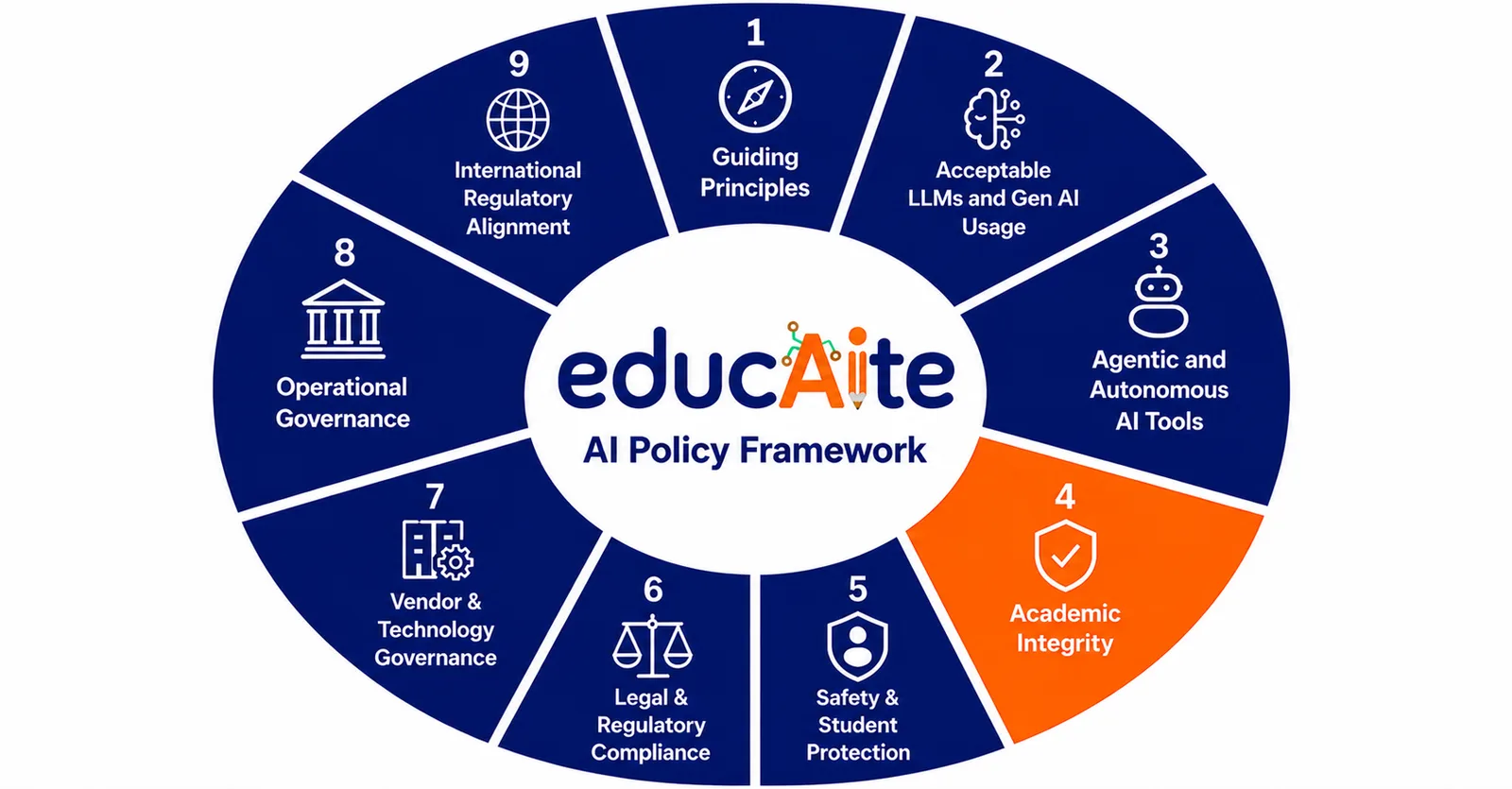
For a lot of teachers and parents, AI use has settled into a simple binary. It's either permissible, and therefore fine, or it isn't, and therefore it's cheating. That instinct makes sense. It's how we want rules to work. But it's not how any other tool in a student's kit actually works. Context has always determined what's acceptable, not the tool itself. Students know when a calculator is fine to use because a teacher has explicitly said so. They understand that a tutor is ok for practice problems and not acceptable during a timed exam. AI needs the same lens; not a light switch, but a framework that helps schools answer six real questions.
What counts as permitted assistance, and what doesn't
Before anything else, a policy needs a clear line between activities, not tools. Brainstorming, editing, drafting, and generating are four different acts with four different implications for a student's learning, and a policy that just says "AI is allowed" or "AI is not allowed" doesn't actually tell a teacher or a student anything useful. Brainstorming with AI to unstick an idea is a different act than asking AI to edit a finished paragraph, which is different still from asking it to draft new content, or generate a full response outright. Each one sits at a different point on the spectrum between support and substitution, and a policy that doesn't name that spectrum leaves teachers making judgment calls assignment by assignment, with no shared standard to point to. Define the activity, not the specific AI tool.
Tucson Unified built a version of this with a stoplight system, borrowed from Agua Fria Union High School District: red for no use, yellow for limited or guided use, green for open use with teacher discretion. It's a smart, simple structure, but here's the part that matters most: it only works if it's the same system in every classroom. If one teacher treats AI brainstorming as green and the teacher next door treats the same activity as red, students aren't learning to make good judgment calls. They're learning to guess which rules apply period to period or even how to game the system. That's not a discipline problem, it's a design problem, and it's one only the school or district can fix. Standards need to be set once, at the school level, and applied consistently, with room for grade-band or subject nuance built into the standard itself, not invented teacher by teacher.
Disclosure has to work like citation, and it has to be school-wide
Once you know what's permitted, the next question is how a student says what they did. This is where the comparison to source citation is genuinely useful. When a student pulls a fact from a journal article, the question isn't "was I allowed to use this source," it's "did I cite it correctly." AI deserves that same instinct. Even light-touch use, like running a grammar pass on a finished paragraph, is still a form of assistance, and it deserves the same disclosure reflex as a footnote. The violation, in most cases, isn't the AI use itself; it's failing to say so.
Teachers need guidance too, not just students
A policy that only talks to students misses half the equation. Teachers need direction on how to design assignments that are either AI-resistant by intent or AI-integrated by intent, so students aren't left guessing which one they're working under. They also need a clear process for handling ambiguous submissions, since AI detection tools are unreliable and false accusations do real damage to trust. And teachers should model the same disclosure habit they're asking of students; if AI helped build a rubric or an assignment prompt, say so.
Consequences should follow misrepresentation, not tool use
When disclosure doesn't happen, the response should be proportional and consistent, not punitive by default. A first instance, especially with a younger student, is usually a teaching moment: a conversation about what disclosure looks like and a chance to correct it. Consequences should escalate around repeated misrepresentation, not around the fact that AI was involved at all. Treating every undisclosed use as an automatic zero-tolerance violation tends to push students toward hiding their process rather than being honest about it, which is the opposite of what the policy is trying to build.
Expectations shift by age, and that's fine
A third grader using AI to brainstorm a story idea is doing something different than a tenth grader using AI to draft a thesis paragraph, and a good policy says so plainly. Younger students benefit from tighter guardrails and more teacher involvement in the "when" and "how." Middle schoolers can start handling more independent judgment calls with clear disclosure habits already built in. High schoolers should be operating close to the standard they'll need in college or a first job: know what you used, and say so without being asked.
This is a graduation competency, not a side policy
The muscle being built here isn't "avoid AI." It's "know what you used and be able to disclose it clearly," and that skill has real economic weight attached to it now. According to NACE's (National Association of Colleges and Employers) Job Outlook 2026 Spring Update, more than a third of entry-level jobs now require AI skills, nearly triple the share reported just six months earlier, and 28% of employers say they're actively seeking early-career candidates who can use AI in their work. That's the population today's students are about to become. Treating AI disclosure as a graduation competency, alongside things like research and citation skills, isn't extra credit. It's preparation.
Next week, we'll move into Part 5: Student Safety, Wellbeing, and Content Guardrails, covering how schools should think about content filtering, mental health flag protocols, and what happens when AI surfaces a concern that needs a human response fast. If your school or district is working through what academic integrity should look like in an AI-integrated classroom, we'd love to help you build it. Reach out to Erica Bishaf at erica@educaitelearning.com or contact us here.