Walk into ten different classrooms in the same school on any given day, and you might see ten completely different relationships with AI.
In one room, a teacher has integrated it thoughtfully into a writing exercise, helping students learn to prompt, critique, and revise. In the next, a teacher believes they have banned it entirely while half the class has a browser tab open in the background or a phone under the desk. Down the hall, a student is using it to think through a hard problem. In the library, another student has offloaded an entire essay to it without reading a word of the output.
And a well-meaning teacher with some technical chops has quietly built a custom AI tutor agent and deployed it in their classroom because they wanted to do something innovative. What they may not realize is that agent could be touching student data in ways that violate state and federal children’s privacy and protection laws.
Without a governance framework, this is just what happens. It is not quite Lord of the Flies, but it is not far off. You get a patchwork of individual decisions made at every level of the organization, each one made with good intentions and almost none of them made with full information. And the district carries the risk for all of it.
This is not a reason to fear AI. It is a reason to govern it.
Start With Values, Not Rules
The instinct when building a policy is to jump straight to the rules: what students can and cannot do, which tools are approved, what counts as cheating. But rules without values are fragile. They get argued around, gamed, and ignored the moment someone finds an edge case.
The foundation of a strong AI governance framework starts somewhere more durable: the values your school community actually holds.
What do your administrators, teachers, students, and families believe about learning? About fairness? About privacy? About accountability? About what it means to do your own work? These are not abstract questions. They are the north star that will anchor every AI decision your district makes, consistently, over time. When a new tool shows up next year that nobody has seen before, your values will tell you whether it belongs in your school before you even open the product demo.
Getting this right requires genuine buy-in, and buy-in requires genuine participation. A governance framework that is handed down from administration without input from teachers, students, and the broader community is a document that will sit in a drawer. The schools that get this right treat the values-setting process as an exercise in civic education. You are not just writing a policy. You are teaching students what it looks like to create shared norms for the collective good. That is a real lesson worth having.
What the Foundation Needs to Cover
Once you have your values in place, the foundation of your framework needs to address six things clearly:
Purpose and scope. Why is AI being used in your district at all, and what is it for? This sounds obvious until you try to write it down. Being specific here prevents scope creep later. If AI is in your school to support learning, accelerate teacher workflows, and prepare students for a world where AI fluency is a baseline job skill, say that. If it is not there for Q&A or to replace teachers, say that too.
Accountability and ownership. Who is responsible for what? What is the chain of command across various use cases? This means thinking beyond the classroom: who oversees tool selection, who manages vendor relationships, who monitors for misuse, who fields a parent complaint, who coaches teachers who want to build agents. Accountability without specificity is just good intentions.
Transparency and explainability. Students, parents, and staff deserve to know when AI is involved in a decision or a process. This does not require technical detail. It requires an honest assessment.
Equity and non-discrimination. AI tools can encode bias. They can also create unequal access. Your framework should commit to evaluating tools through an equity lens and ensuring that AI does not widen gaps it was supposed to close.
Human oversight. Across every use case in your district, a human needs to be in the loop. AI should inform and support human judgment, not replace it. This is especially true for anything touching student wellbeing, discipline, or academic records.
Prohibited use cases. Some things AI should simply not do in a school. Defining these explicitly, before a situation arises, is far better than figuring it out after the fact.
How to Actually Get Started
I don’t recommend starting with a blank policy document. Begin with a whiteboard.
Gather your key stakeholders and start by mapping the real problems AI is already creating or could create in your school. Be honest. Where is there inconsistency? Where is there risk? Where are students already ahead of the adults in the room?
From that list, identify the top five challenges worth prioritizing. For each one, push yourself to articulate the actual problem, why it matters to your community specifically, a proposed solution grounded in your values, and clear next steps with named owners and timelines.
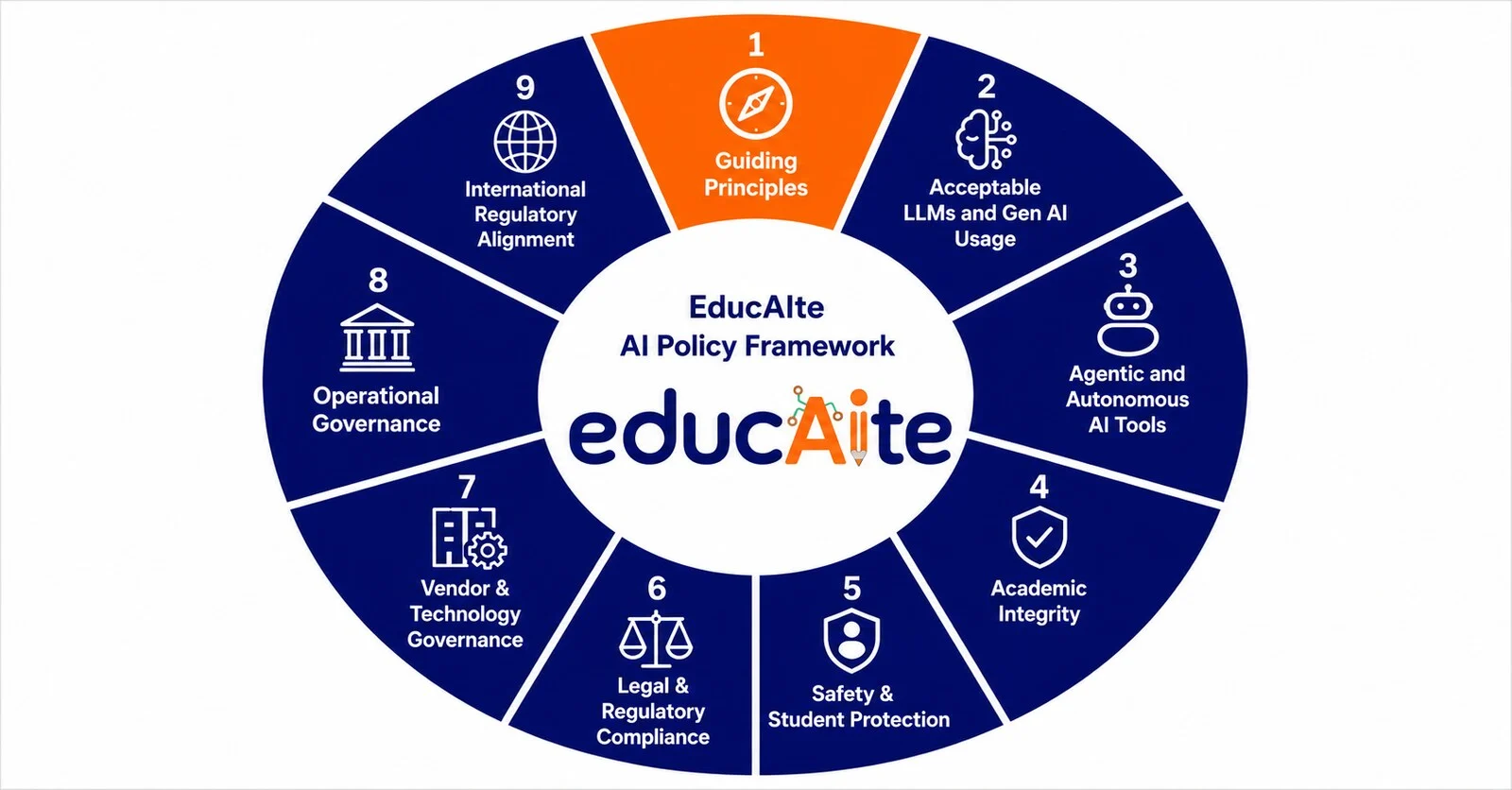
The nine sections of the EducAIte AI Policy Framework, covered in detail throughout this series, are built to do exactly this work. The foundation you lay here is what makes the other eight coherent. Without it, you have rules. With it, you have a framework.
Next in the Series
We’ll cover acceptable use for LLMs and generative AI tools, including what teachers and students can do, what requires disclosure, and what is off-limits.
Want us to work through this framework with your school or district? Visit our workshops or reach out to Erica Bishaf at erica@educaitelearning.com.